
The AI operating system
for construction.
ConstructEther replaces the fragmented stack of ten disconnected tools with one AI-native commercial backbone — built for the firms that price work and run projects in an industry that can no longer hire its way out of its commercial shortage.
Construction output figure: ONS, Construction output in Great Britain. Great Britain, 2025.
Why construction. Why now.
Three structural shifts have compressed the window. The platforms that win it set the standard for the next decade.
Senior talent has become a permanent constraint.
Senior commercial salaries have outpaced fee scales for a decade — and there is no pipeline of replacements coming. The industry cannot hire its way through the shortage. AI is the only intervention that scales output without scaling headcount.
The Building Safety Act has rewritten the rules.
Golden thread evidence is mandatory. Gateway approvals are personal-liability moments. The firms with the cleanest commercial workflows will inherit the work — and everyone else will pay the audit cost, repeatedly, on every project.
AI capability has crossed the threshold.
Take-off, BoQ generation, scope-gap detection, live cost reconciliation — operationally viable today, not future capability. The first platforms to unify them as a single commercial backbone will set the standard for the next decade.
Three ways margin walks off site.
And what it costs to ignore them.
Pricing in the dark
Bidding off spreadsheets and gut feel. A 2% error on a £500k package is £10k of margin — every time you submit.
Chasing payment
Late applications. Missed notifications. Unpriced variations. The Construction Act is on your side — but only if your paperwork is.
No QS in the room
When the main contractor's QS fires a pay-less notice, who responds? If the answer is "next week", you're already losing.
One platform. Four engines.
Each module is built around a single commercial outcome — and they share data, so what you cost flows into what you tender, what you tender flows into what you build, and what you build proves compliance automatically.
Tender Intelligence
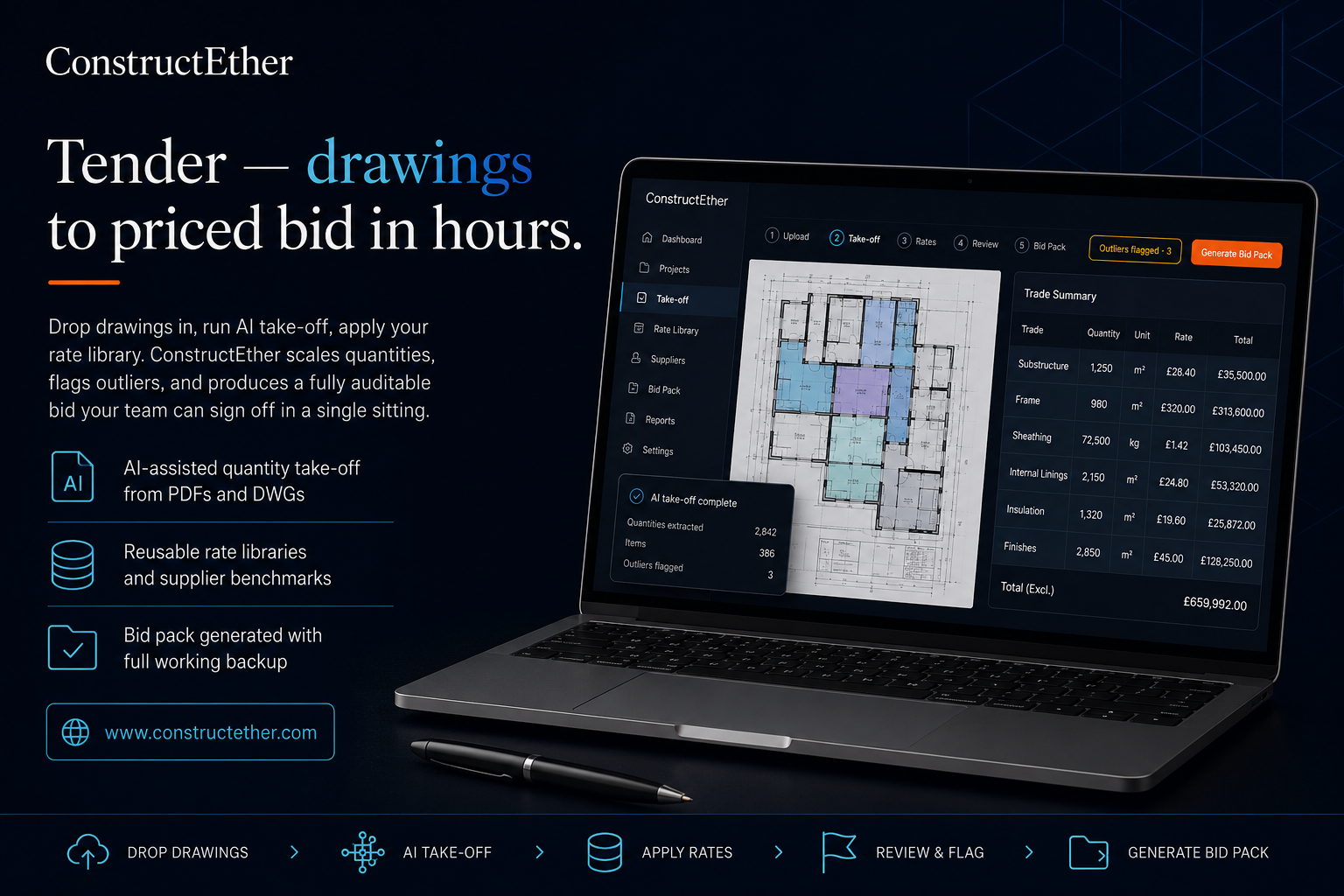
Drawings in. Priced bid out. Drag-and-drop take-off, AI quantity scaling, and live rate libraries compress days of work into hours — with audit trail baked in.
Stage 01 · In beta nowCommercial Engine
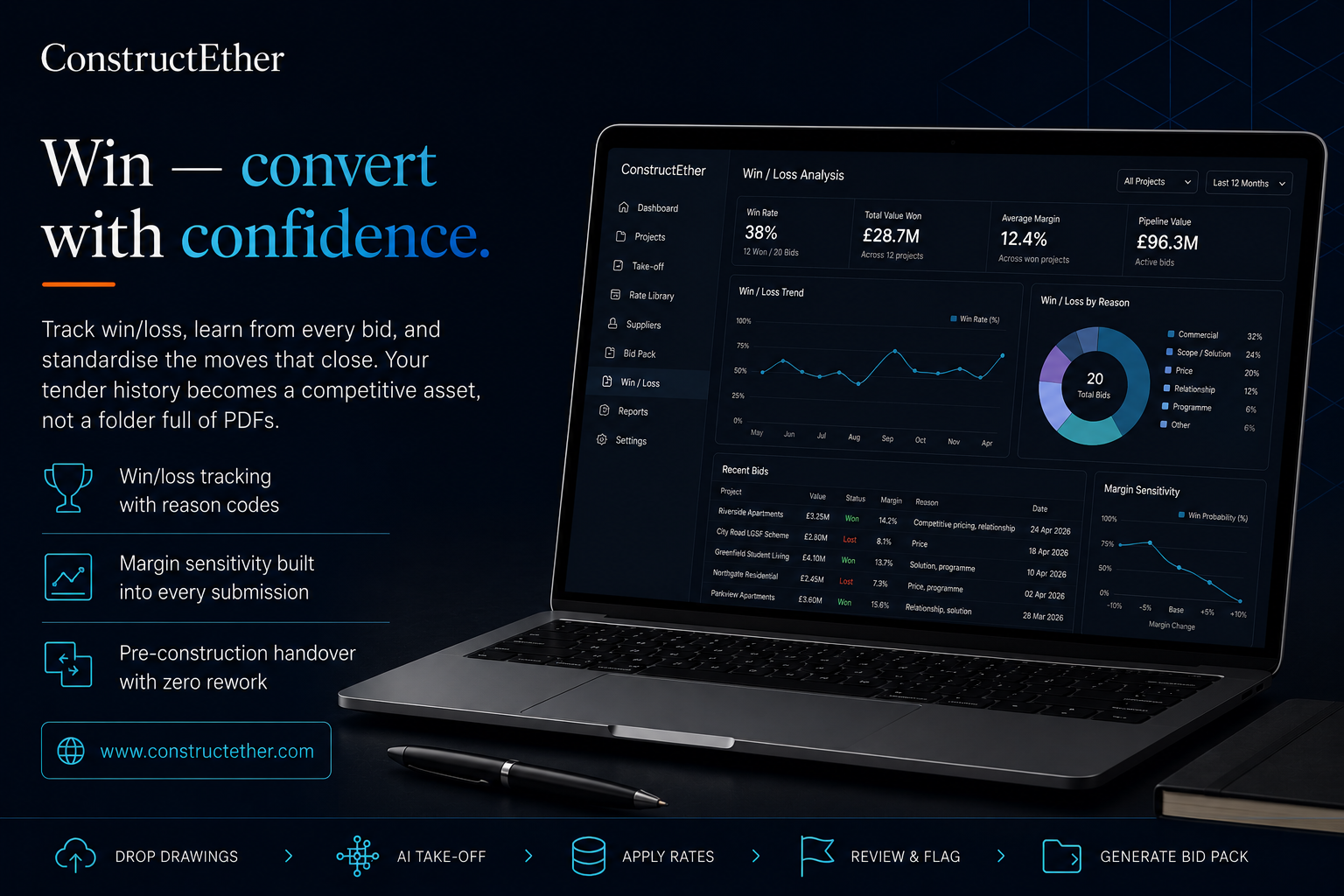
Cost plans, valuations, variations, and final account — all running off the same dataset. Margin moves are visible the moment they happen, not at the end of the month.
Stage 02 · 2027Project Delivery
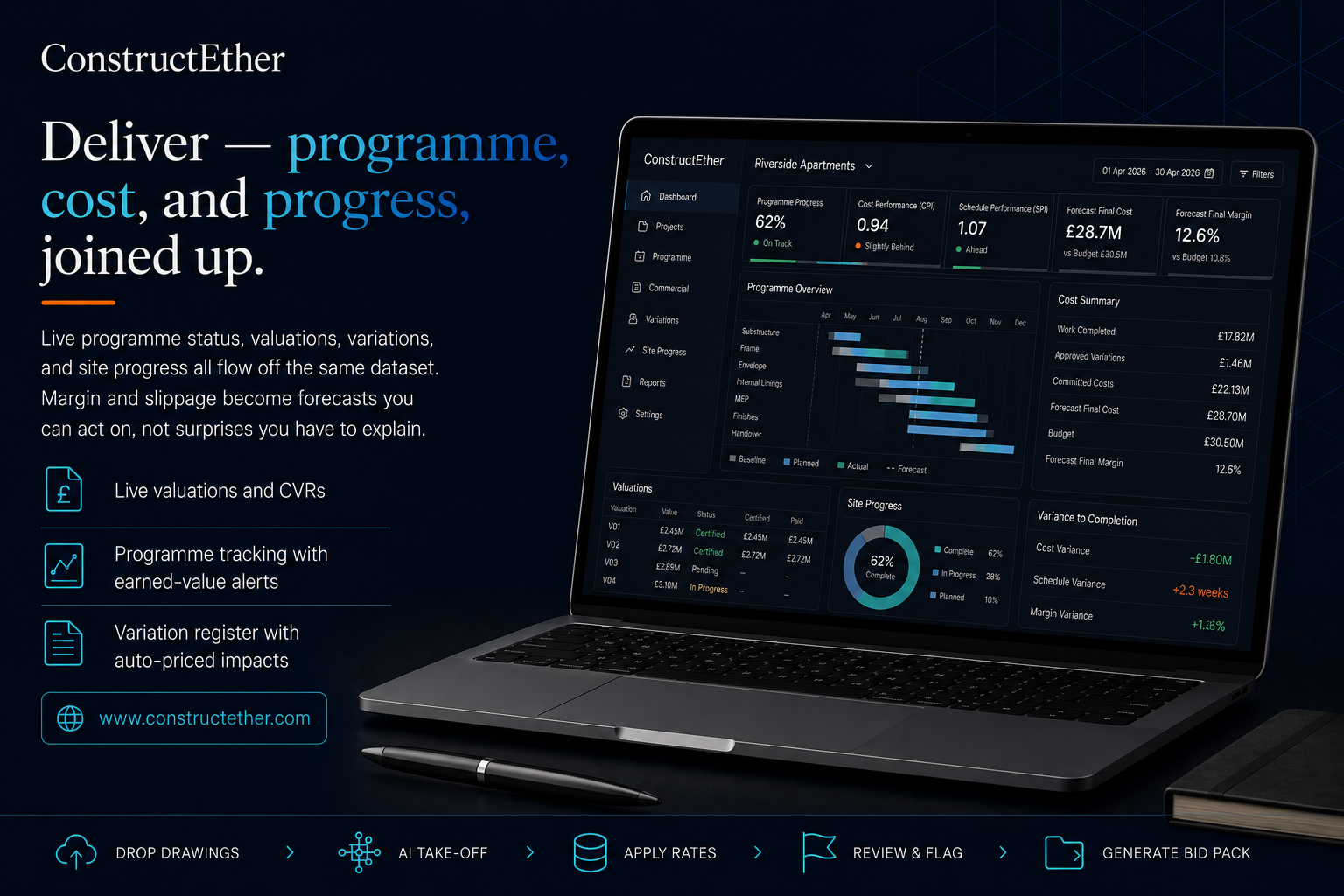
Programme, RFIs, instructions, and site progress in one place — synced with the commercial side so a delay shows up as a forecast, not a surprise.
Stage 03 · 2027Compliance
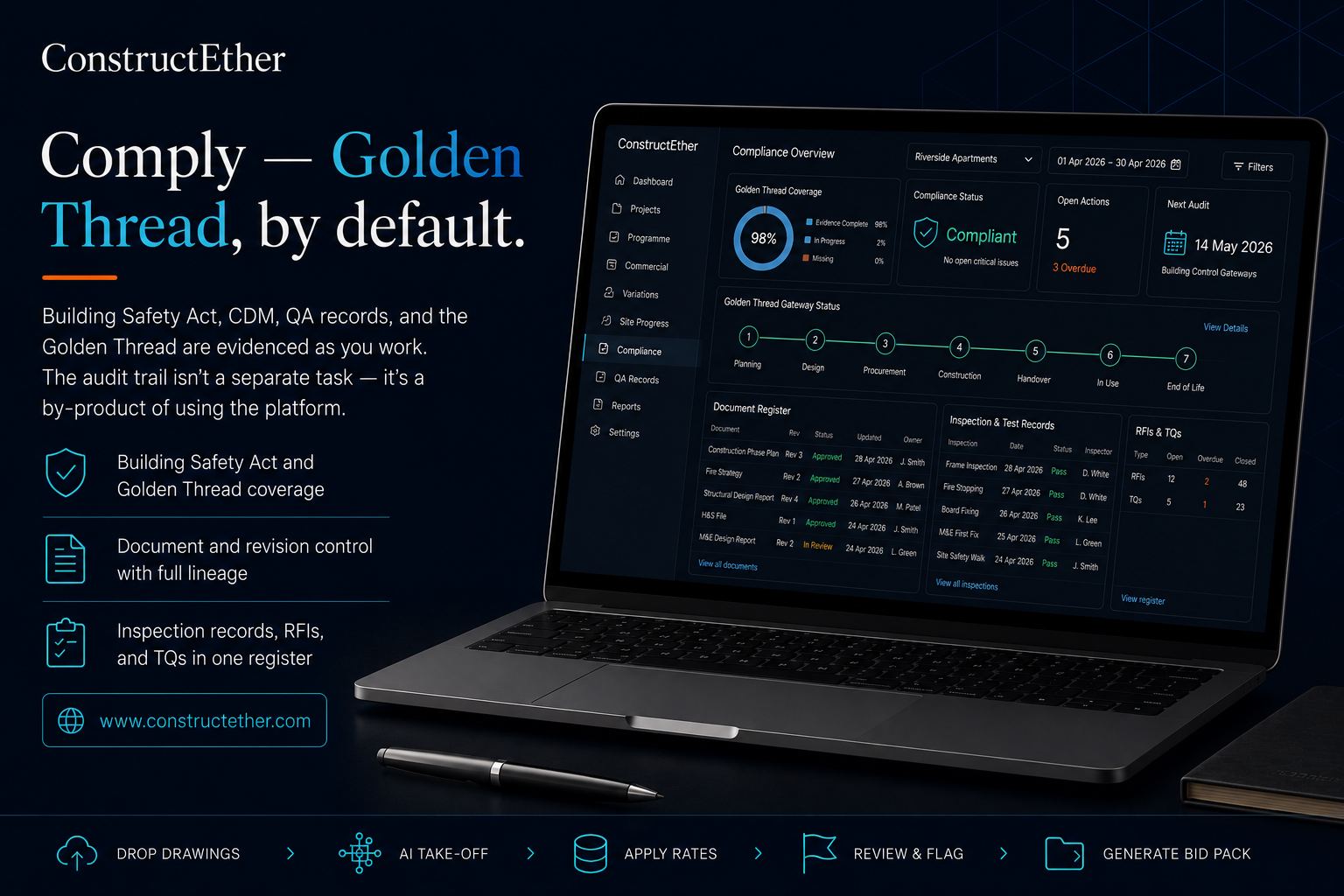
Building Safety Act, Golden Thread, CDM, and QA all evidenced as you work — not retrofitted the night before the auditor arrives.
Stage 04 · 2027–28Released in stages, by design. Tender Intelligence is in closed beta with our Founding Partners now, through to the end of 2026, with full launch in Q1 2027. Commercial Engine, Project Delivery and Compliance follow in sequence through 2027–28 — so you adopt at the pace your firm can absorb, not in a single weekend.
For the firms that turn drawings into buildings.
ConstructEther is built primarily for large trade contractors carrying multi-million-pound packages — and the main contractors, QS firms, and developers who depend on them.
Contractors
Price bigger packages, run leaner sites, and prove compliance on the projects that move your business forward.
Concrete · Light gauge steel · Structural steel · Partitions · Dry lining · M&E · Cladding · Curtain walling · Groundworks · and moreMain Contractors
Tender, deliver, and prove compliance from one platform — with margin and programme visible to leadership in real time.
QS & PM Firms
Win more bids in less time. Run accurate cost plans and valuations without juggling four spreadsheets and an inbox.
Developers
One source of truth across consultants and contractors. Know what's costing, what's slipping, and what's at risk before the next board meeting.
From a stack of workarounds to one platform.
Ten disconnected tools. Duplicated. Out of control.
One platform. One source of truth. Total control.

- AI Orchestration
- Data Normalisation
- Commercial Intelligence
- Real-Time Synchronisation
Four steps. One workflow.
Built by the people who lived the problem.
Forty-five years of UK construction between the commercial founders — and a security-first engineering discipline underneath it. Not a tech team guessing at what a QS needs.

John Ellis
John has spent 25 years in UK construction — starting as a labourer for bricklayers and plasterers, working through the trades, and qualifying as a Quantity Surveyor. Thirteen of those years have been in commercial roles across Mace, Morgan Sindall, Esh Group, Elliott/Modulaire and Lindum, delivering in excess of £275 million of construction works. He practises as a Senior QS today. Twenty-five years in, the conclusion was unavoidable: construction doesn't have a software problem — it has a fragmentation problem. ConstructEther is built to fix it.
Connect on LinkedIn
Andrew Elsworth
Andrew brings over twenty years inside UK construction to ConstructEther — from trainee QS at Lovell to Commercial Director, and co-founder of a contracting business he scaled to £5m turnover in three years. He now runs Dawn Consult, most recently delivering PM and QS services on the £5m RAF Leeming hangar refurbishment. At ConstructEther he owns the commercial workflow and the numbers behind it.
Connect on LinkedIn
Chris Boyle
Chris builds security into ConstructEther from the codebase up — access control, data protection and secure development practice designed in from the first commit rather than retrofitted before an audit. Data residency is configured to each client's own compliance requirements, not a one-size-fits-all default. It's the discipline that has to be in place before a contractor puts its commercial data on any platform.
See if your firm is a fit.
Two-minute fit assessment, then a twenty-minute walkthrough on a live project — yours, if you want. We only onboard firms ready to replace their existing stack, not just trial another tool.